Registering a hire purchase company in Nepal means meeting requirements set by the Nepal Rastra Bank (NRB), the Company Act 2063, and as of 11 August 2026 a major sixth amendment to NRB’s hire purchase policy that rewrites the rules on licensing, capital, interest rates, and compliance. If you’re starting a new hire purchase company or already run one, this amendment changes what you need to file, how your license is renewed, and what penalties apply if you get it wrong.
This guide walks through the updated legal framework, minimum paid-up capital requirements, step-by-step registration process, required documents, and the new compliance obligations introduced by the 2026 amendment. For end-to-end support with hire purchase company registration and NRB compliance, Niti Partners & Associates a leading corporate and banking law firm in Nepal, can guide you through the process.
What Is a Hire Purchase Company in Nepal?
A hire purchase company is a specialized financial institution established under the Companies Act, 2063 and explicitly licensed by the Nepal Rastra Bank (NRB) under Section 76 of the Nepal Rastra Bank Act, 2058. These entities provide installment-based financing for agricultural, industrial, commercial, or domestic assets including vehicles, machinery, and electrical appliances like refrigerators, washing machines, and vacuum cleaners where ownership transfers to the client only after all installments are completely settled.
Legal Framework Governing Hire Purchase Companies
Hire purchase transactions and specialized lending companies operate under a tightly monitored legal architecture:
- Primary Governing Statute: The Policy and Procedural Arrangement for Granting Approval to Hire Purchase Loan Companies, 2013, issued by the Bank and Financial Institution Regulation Department of NRB.
- Corporate Foundation: Company Registration in Nepal provisions under the Companies Act, 2063.
- Central Bank Oversight: Section 76 and Section 79 directives issued by the Nepal Rastra Bank, alongside compliance frameworks managed via our NRB Compliance Services practice.
What Changed in the August 2026 (Sixth) Amendment
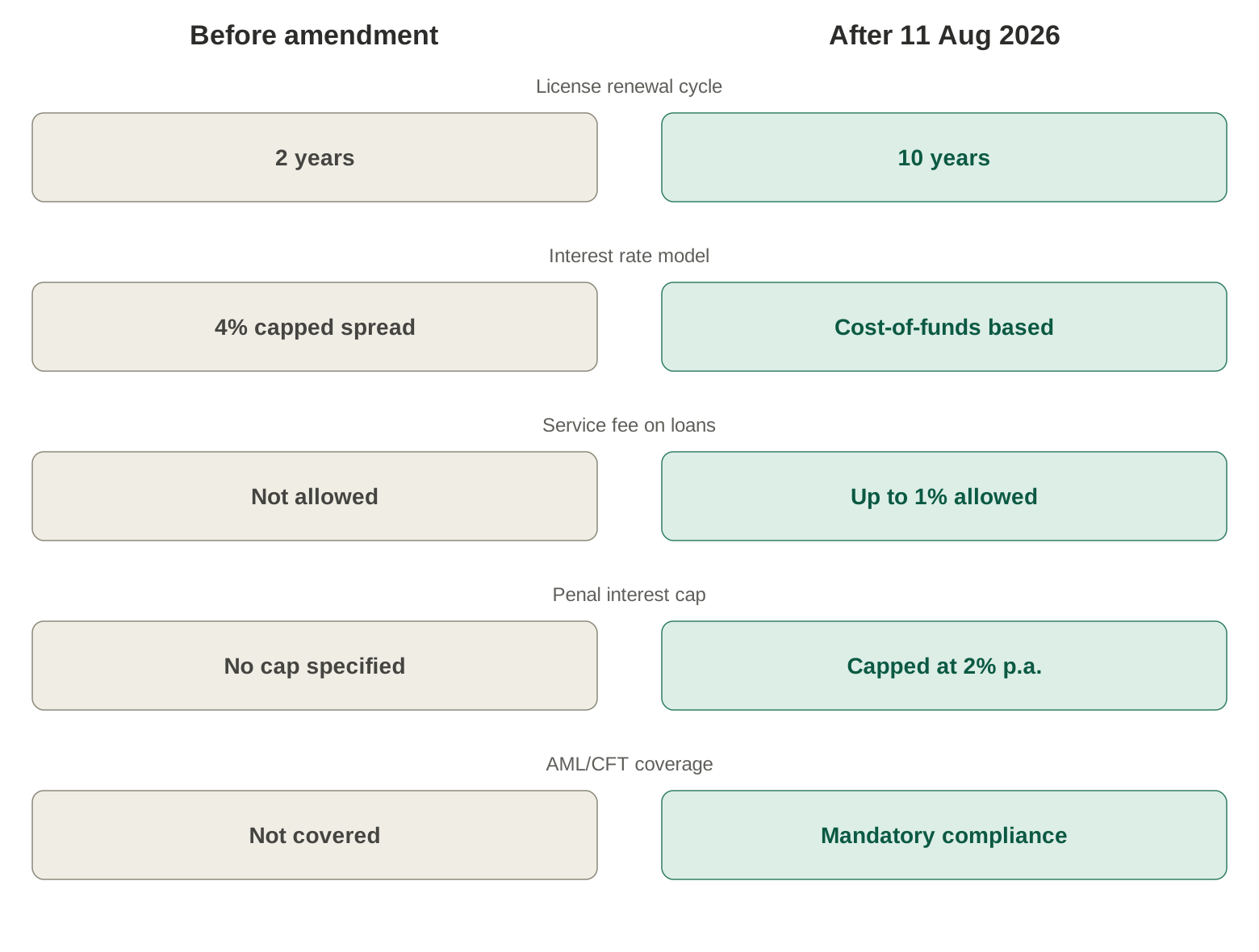
The August 2026 regulatory overhaul introduced tighter governance, stricter consumer protection rules, and broader institutional accountability. The evolution of these rules is summarized below:
Regulatory Parameter | Previous Framework | Updated Framework (August 2026 Amendment) |
License Renewal Cycle | Every 2 years | Every 10 years (Fee: NPR 200,000) |
Interest Rate Model | Fixed or 4% capped spread model | Cost-of-funds + published premium model (Max 2% fluctuation) |
Service Fee & Penalties | Unregulated or variable structures | Max 1% service fee; Penal interest capped at 2% p.a. (no interest-on-interest) |
Fit and Proper Test | Initial establishment check only | Mandatory at both establishment AND 10-year license renewal |
Executive Qualifications | General corporate management | CEO/MD must hold a formal bachelor’s degree |
AML / CFT Compliance | Limited direct tracking | Formal, first-time inclusion under national AML/CFT framework |
Eligibility and Minimum Paid-Up Capital Requirements
To qualify for an NRB license, promoters must satisfy stringent entry barriers designed to maintain system stability:
- Minimum Paid-Up Capital: Companies must maintain a mandatory minimum paid-up capital of NPR 300 Million (NPR 30 Crores) in ordinary shares.
- Fit and Proper Test: All founder shareholders, promoters, and board directors must clear the statutory Fit and Proper Test (Schedule-3) before license approval or renewal.
- Executive Leadership: The Chief Executive Officer (CEO) or Managing Director (MD) must hold at least a bachelor’s degree from a recognized university.
Step-by-Step Registration Process
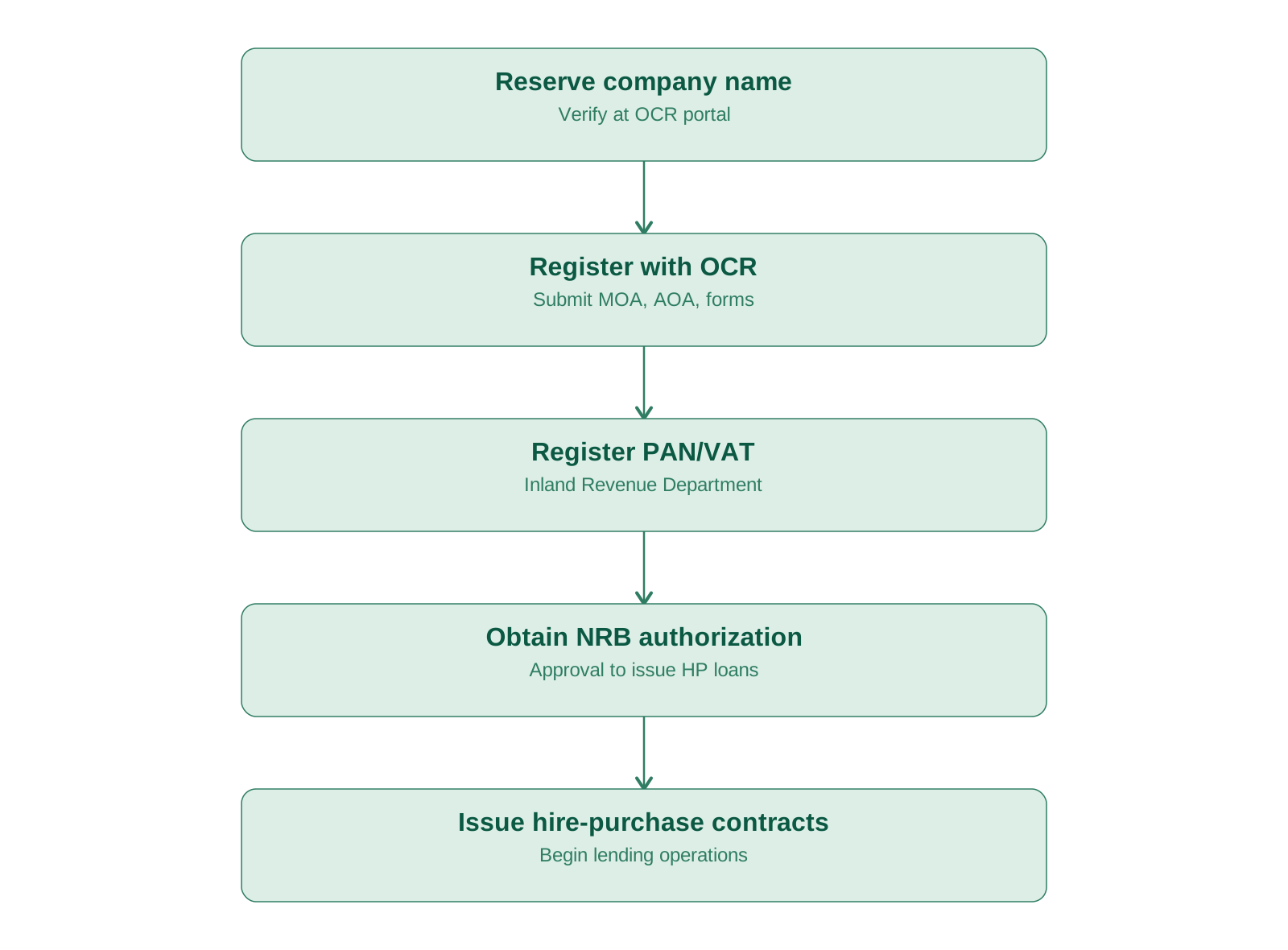
- Company Incorporation: Register the corporate entity under the Companies Act, 2063 at the Office of the Company Registrar (OCR) using the mandatory suffix (“………. Hire Purchase Pvt. Ltd.” or “………. Hire Purchase Ltd.”).
- Application Filing: Submit a formal application to NRB under Schedule-1 along with a non-refundable processing fee voucher equivalent to 0.2% of the proposed paid-up capital.
- Documentation & Scrutiny: Attach detailed feasibility reports, business plans, and promoter disclosures as outlined in Schedule-2.
- Fit and Proper Clearance: Undergo background checks and evaluations for all proposed directors and major shareholders.
- License Issuance & Operation: Secure formal approval under Section 76 of the NRB Act and commence commercial operations within 6 months to prevent automatic license revocation.
Documents Required for Registration
- Certified copies of the Memorandum of Association (MoA) and Articles of Association (AoA).
- Certificate of Incorporation issued by the Office of the Company Registrar (OCR).
- Detailed personal and professional profiles, tax clearances, and net-worth declarations of all promoters for the Fit and Proper Test.
- Board resolutions and commitments regarding minimum capital adequacy and infrastructure readiness.
- Source of funds declaration and compliance framework drafts.
License Renewal, Fees, and Penalties Under the New 10-Year Cycle
- Decennial Renewal: Licenses must now be renewed every 10 years by the end of Shrawan following the fiscal year-end, accompanied by a renewal fee of NPR 200,000 and Schedule-5 documentation.
- Delayed Renewal Surcharges:
- 10% surcharge if renewed between the end of Shrawan and mid-September (end of Bhadra).
- 20% surcharge if renewed through mid-October (end of Ashoj).
- Permanent Revocation: Failure to file for renewal by the final deadline results in automatic and permanent cancellation of the license, with no option for re-issuance.

Interest Rate, Service Fee, and Penal Interest Rules
- Interest Rate Benchmarking: Lending rates must be pegged to the Cost of Funds (calculated using the weighted average cost of equity and debt funds). Published rates cannot fluctuate by more than 2% for active borrowers.
- Service Fee Caps: Companies can charge a maximum of 1% as a service fee on approved loans.
- Penal Interest Limits: Overdue penal interest is strictly capped at 2% per annum over the normal lending rate, calculated only on the overdue principal amount. Compounding or charging “interest-on-penal-interest” is prohibited.
Compliance Obligations (AML/CFT, Reserve Fund, Loan Classification)
- Anti-Money Laundering (AML/CFT): Hire purchase companies are formally integrated into Nepal’s AML/CFT regulatory perimeter, requiring rigorous customer due diligence (CDD), enhanced monitoring of high-net-worth clients, and suspicious transaction reporting.
- Mandatory Reserve Fund: Entities must maintain a general reserve fund, allocating at least 20% of net profits annually until the reserve equals twice the paid-up capital, after which at least 10% must be added annually.
- Asset Classification & Provisioning:
- Good (Performer): Installments overdue up to 6 months (Nil loan loss provision).
- Doubtful: Installments overdue between 6 to 12 months (50% loan loss provision).
- Bad (Loss): Installments overdue beyond 12 months (100% loan loss provision on total outstanding debt).
- Credit Information & PAN: Mandatory credit information reporting from the Credit Information Bureau (CIB) for loans exceeding NPR 1 Million, and Permanent Account Number (PAN) submission for loans exceeding NPR 2.5 Million. Prior NRB approval is also mandatory before relocating any branch or office.
Common Mistakes That Delay Hire Purchase Registration
- Failing to secure pre-approval name clearance incorporating the mandatory “Hire Purchase” nomenclature.
- Submitting incomplete promoter disclosures, leading to delays or rejections during the fit and proper test.
- Underestimating the capital adequacy and infrastructure requirements mandated by NRB prior to filing.
- Neglecting upcoming AML/CFT operational protocol requirements during initial business setup.
Why Work With a Law Firm for Hire Purchase Registration
Navigating the intersection of company law, central bank compliance, and FDI frameworks involves significant regulatory exposure. DIY filings often stall due to strict documentation standards or shifting circular interpretations, risking substantial capital and operational delays. Partnering with a dedicated corporate team ensures seamless interaction with regulatory bodies.
For expert legal structuring, licensing applications, and ongoing compliance management, business leaders trust Niti Partners & Associates . As a leading Corporate Law Firm in Nepal with deep expertise in Banking & Finance Practice, we guide domestic and international clients through every stage of establishment. Book a free consultation or talk to our hire purchase registration lawyers today.
Frequently Asked Questions (FAQs)
What is the minimum paid-up capital for a hire purchase company in Nepal?
Under current NRB regulations, a specialized hire purchase company must maintain a minimum paid-up capital of NPR 300 Million (NPR 30 Crores).
How long does hire purchase company registration take?
The entire process spanning company incorporation at the OCR, central bank licensing, and infrastructure clearance typically takes between 2 to 3 months, subject to prompt documentation review.
What is the new license renewal period after the 2026 amendment?
Following the August 2026 amendment, operating licenses must be renewed every 10 years instead of every 2 years, accompanied by a fee of NPR 200,000.
Do existing hire purchase companies need to rename themselves?
Yes. Existing entities must include “Hire Purchase” in their corporate name and notify the central bank within prescribed timelines to comply with updated naming mandates.
What happens if I miss the license renewal deadline?
Missing the final extended renewal deadline (mid-October) results in the permanent revocation of the hire purchase license, with no provision for re-issuance to the same entity.
Is a hire purchase company subject to AML/CFT rules in Nepal?
Yes. Under the updated regulatory framework, hire purchase companies are fully integrated into the national AML/CFT compliance regime, requiring robust customer identification and transaction monitoring systems.
Can foreign investors register a hire purchase company in Nepal?
Foreign investors can establish or invest in financial entities subject to prior approvals under the Foreign Investment and Technology Transfer Act (FITTA), Department of Industry (DoI) clearance, and strict NRB foreign exchange regulations. For structured assistance, explore our Foreign Investment Approval practice page.
FURTHER READINGS
- Niti Partners & Associates — Home & Contact (Niti Partners & Associates)
- Company Registration Services (Company Registration in Nepal)
- NRB Compliance Advisory (NRB Compliance Services)
- Banking & Finance Practice (Banking & Finance Practice)
- Corporate Law Practice (Corporate Law Firm in Nepal)
- Foreign Investment Services (Foreign Investment Approval)
- Nepal Rastra Bank Official